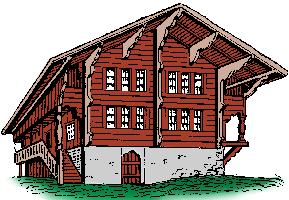
We stayed overnight at a ski chalet.
a mountain chalet for weekend getaways
Recent Examples on the Web
Examples are automatically compiled from online sources to
show current usage.Read More
Opinions expressed in the examples do not represent those of Merriam-Webster or its editors.
Send us feedback.
Behind its imposing wood and stone exterior, suites outfitted in pine furniture and crisp white linens read chalet-chic.—
Condé Nast,
Condé Nast Traveler,
8 Oct. 2026 While the main chalet offers space for family gatherings—long dinners prepared on a La Cornue range followed by listening sessions with music from a vintage jukebox in the playroom—the wellness zone on the lower level invites a slower rhythm.—
Michael James Gardner,
Architectural Digest,
8 Oct. 2026 The team that plays in a stadium where balls never soar above Bernie Brewer’s chalet?—
Tyler Kepner,
New York Times,
4 Oct. 2026 The advisors also work closely together on each request, taking a holistic approach that gives members access to everything from superyachts and private jets to off-market chalets and private islands.—
Rachel Cormack,
Robb Report,
14 Sep. 2026 See All Example Sentences for chalet
Word History
Etymology
borrowed from French, borrowed from Franco-Provençal of Switzerland (and adjacent Alpine regions of France and Italy) tsalẹ̀, tchalè "cabin in upland summer pastures used as a residence and for processing milk into butter and cheese, pasture in the vicinity of such a structure," from tsal-, tchal-, stem probably meaning "shelter" seen as an underived noun in Old Occitan cala "cove, inlet" (also in Spanish & Catalan, and as a loanword from Spanish in Italian & Portuguese, probably a borrowing from a western Mediterranean substratal language) + -ẹ̀, -è-et entry 1
Note:
A display of the variants found in Franco-Provençal of Switzerland can be seen in Glossaire des patois de la Suisse romande (tome 3, p. 270). The word occurs as chaletus in Latin documents from present-day Vaud canton beginning in the fourteenth century. As chalet the word is first attested in metropolitan French in 1723; it received wide circulation through its use in Jean-Jacques Rousseau's novel Julie ou la Nouvelle Héloïse (1761).


 Copy Citation